 |
|||
 |
|||
 |
 |
 |
|
 |
|
 |
 |
 |
|||
 |
|||
 |
|||
 |
 |
|
86w1tlqkvia The Intricacies of Hosting Provider CompaniesIn the bustling digital age, where the online presence of a business can make or break its success, the role of a hosting provider company becomes undeniably crucial. These entities, often working behind the scenes, are the unsung heroes ensuring that websites are accessible and running smoothly for millions of users around the globe. But what exactly does a hosting provider do, and how do they operate? Let's delve into the inner workings of these indispensable organizations. At its core, a hosting provider company offers the technologies and services needed for a website or webpage to be viewed on the Internet. Websites are hosted, or stored, on special computers called servers. When Internet users want to view your website, all they need to do is type your website address or domain into their browser. Their computer will then connect to your server, and your webpages will be delivered to them through the browser. This seemingly straightforward process is backed by a complex infrastructure and a range of services. Firstly, let's discuss shared hosting. This is akin to renting an apartment in a large complex. Your website will share server resources, such as RAM and CPU, with other websites. It's a cost-effective solution for small businesses or personal websites with moderate traffic. However, one must consider potential drawbacks, such as slower load times during peak traffic due to resource sharing. For those seeking more control and resources, dedicated hosting offers a compelling alternative. In this setup, your website resides on its own server, providing you with unparalleled performance and security. Naturally, this comes at a higher cost, but it's a worthy investment for larger businesses with significant online traffic. Another popular option is VPS hosting (Virtual Private Server), which strikes a balance between shared and dedicated hosting. While still sharing a physical server, each website is allocated a dedicated portion of the server's resources, ensuring better performance than shared hosting without the high costs of dedicated servers. Cloud hosting has gained significant traction in recent years, offering scalability and flexibility that traditional hosting types may lack. With cloud hosting, your website is hosted across a network of servers, allowing for automatic resource allocation and redundancy. This means that even if one server fails, others can pick up the slack, ensuring minimal downtime and robust performance. Security is another paramount concern for hosting providers. They employ various measures to protect data, such as firewalls, malware scanning, and DDoS protection. Regular updates and patches are applied to keep the infrastructure secure from ever-evolving threats. Many providers also offer SSL certificates, crucial for encrypting data and establishing trust with visitors. Moreover, the customer support offered by hosting providers can greatly impact the user experience. A reliable provider will offer 24/7 support through various channels like live chat, email, or phone. This ensures that any issues encountered can be resolved swiftly, minimizing disruptions to your online presence.
Choosing the right hosting provider involves weighing these factors against your specific needs. While some may prioritize cost, others may focus on performance and security. The landscape of hosting providers is vast and varied, with companies offering bespoke solutions to meet diverse requirements. In conclusion, hosting provider companies are the backbone of our digital world, ensuring that the vast expanse of the Internet remains accessible, reliable, and secure. Their role, though often overlooked, is vital in maintaining the seamless functioning of the online ecosystem. https://www.whtop.com/top.100-alexa-ranking
The big list of best 100 webhosting companies (updated Feb, 2025). The #1 company is godaddy.com, Semrush:857, Links:928013316, over 46952259 domains. https://www.rackspace.com/library/what-are-web-hosting-services
Usually used for hosting websites, a web hosting service can also be used to host company email, files, games and other content. Web hosting services enable ... https://cybernews.com/best-web-hosting/
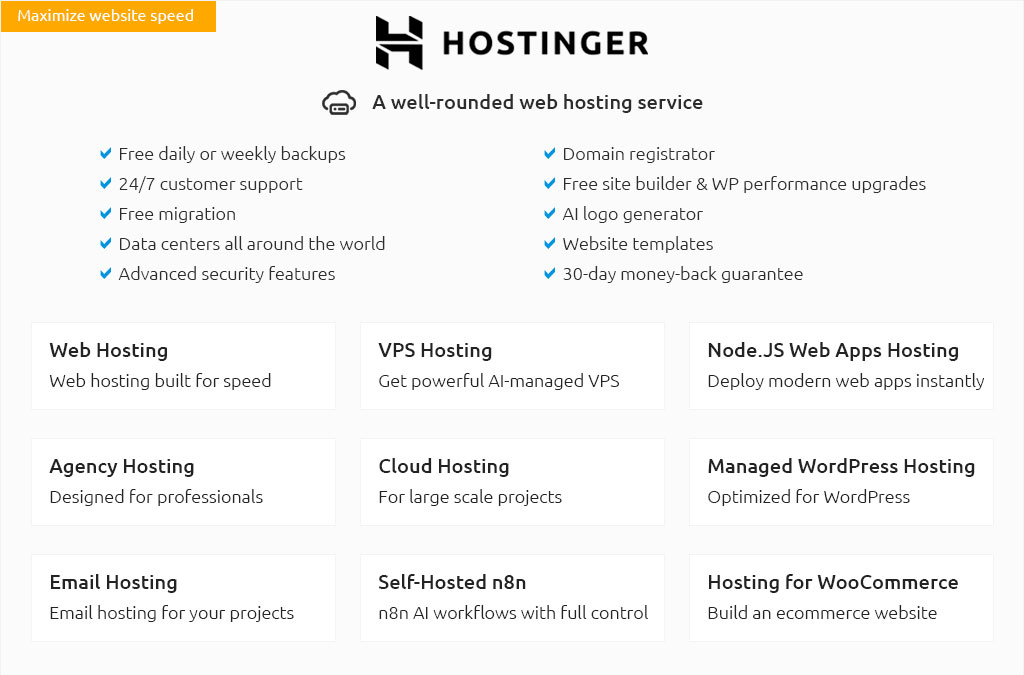
Hostinger is the #1 hosting provider that offers an affordable service without compromising performance. It is also user-friendly and perfect ...
|
